The Design of Light

Fluorescent Diamonds

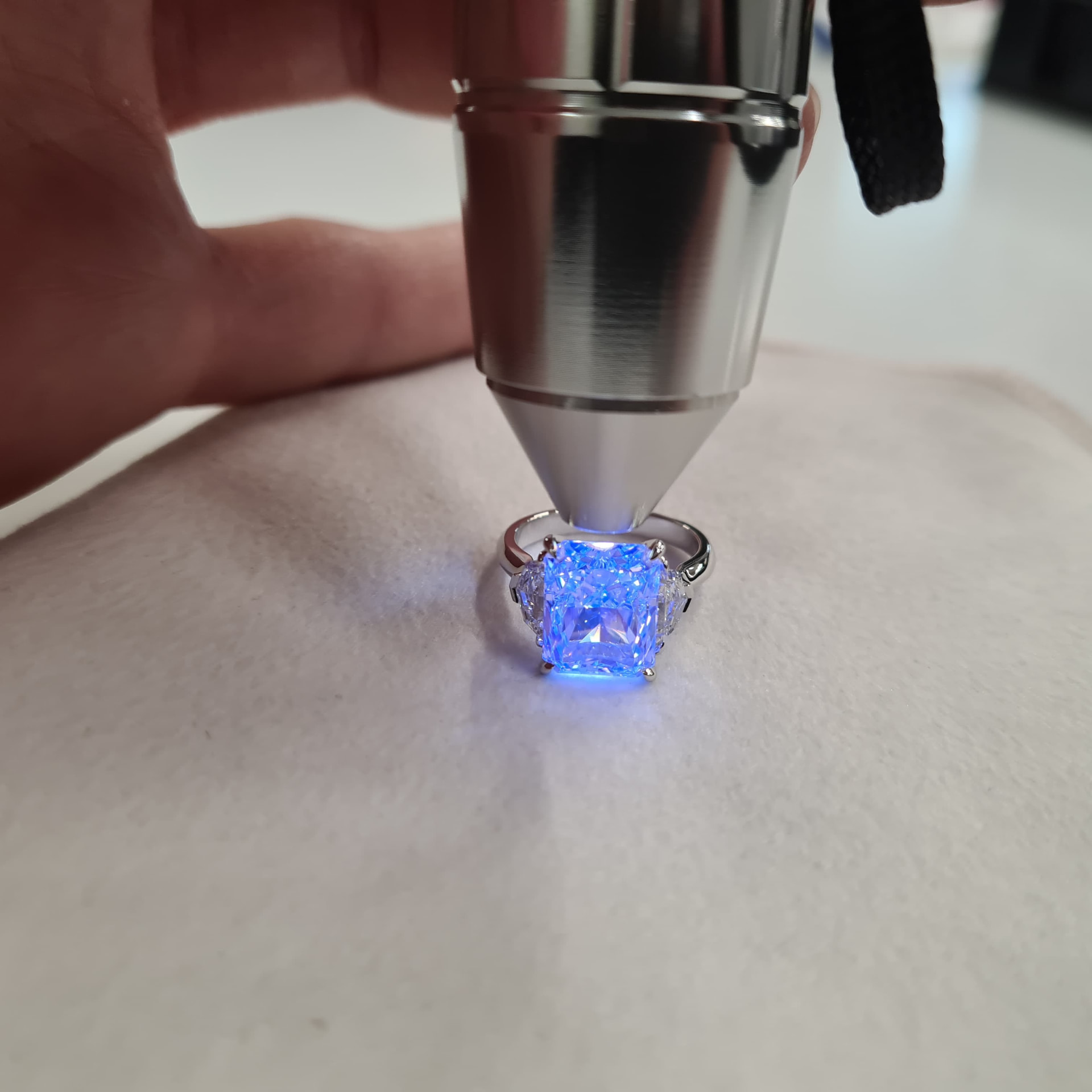
Fluorescent diamond revealing a blue glow under UV light

A close-up of a diamond ring illuminated by UV light, revealing the centre diamond's intense blue fluorescence - a natural glow hidden within the stone and visible only under UV light.

Fluorescent diamonds are natural diamonds that reveal visible colour when exposed to ultraviolet light. This phenomenon, known as diamond fluorescence, allows certain stones to glow under UV light and disclose a hidden dimension of colour. At Katerina Sibilia, fluorescent diamond jewellery is designed around this duality: the jewel seen in daylight, and the jewel revealed when the light changes.

Formed deep within the earth over millions of years, each diamond carries within it a unique internal structure - a precise arrangement of atoms shaped by pressure, temperature and time.

In some diamonds, this structure holds the ability to interact with ultraviolet light in a remarkable way: to absorb energy and return it as visible colour. This is fluorescence.

Not all fluorescence is equal. In most diamonds, it is faint or barely perceptible. In rare cases, it is expressive, balanced and beautiful - strong enough to become part of the design itself.

What is fluorescence?

Fluorescence is the emission of light by a material while it is excited by an external energy source, most commonly ultraviolet radiation.

In gemology, fluorescence is part of a broader family of light-emission phenomena known as luminescence. More specifically, it belongs to photoluminescence - light emission triggered by photons.

In diamonds, ultraviolet light provides energy that is absorbed within the crystal. This energy is then released almost instantaneously as visible light. The process occurs on an extremely short timescale - typically within fractions of a second - which is why the glow disappears immediately when the ultraviolet source is removed.

A variety of terms are used to describe light emission in materials, including luminescence, fluorescence and phosphorescence. Fluorescence refers specifically to emission that stops as soon as excitation ends, whereas phosphorescence continues after the excitation source is removed.

What is a fluorescent diamond?

A fluorescent diamond is a diamond that emits visible light when exposed to ultraviolet light.

This can happen under a dedicated UV lamp and, in some cases, under UV-rich daylight such as strong sunshine. In natural diamonds, this glow is most often blue, although other colours can occasionally appear, including yellow, orange, green, red and purple.

Once the ultraviolet light source is removed, the diamond stops fluorescing. Fluorescence is the strength of a diamond's reaction to ultraviolet light.

This reaction is governed by specific “luminescence centres” within the diamond - microscopic structural features that act as sites where energy is absorbed and re-emitted.

What colours can diamond fluorescence be?

The presence of fluorescence does not replace the diamond's natural colour. It reveals its secret, hidden colour.

In normal daylight conditions, a diamond's colour is its body colour - the natural tone of the stone as it appears in daylight. This is the colour assessed by gemological laboratories and recorded on a diamond certificate, typically on a scale from colourless to faint yellow or beyond.

Under ultraviolet light, a diamond may reveal its inner self. The most common fluorescence colour in diamonds is blue - often a deep, electric, almost liquid blue, with a richness that can feel entirely different from the diamond's daylight appearance. Other colours can also occur, although they are significantly rarer. These include yellow, orange, green, pink, red and purple. When present, these fluorescent colours can appear vivid, saturated and intensely alive, as if the colour is coming from within the stone rather than sitting on its surface. Each colour is linked to specific atomic features within the diamond's structure.

The presence of fluorescence does not replace the diamond's natural colour. It reveals something more.

At Katerina Sibilia, diamonds are selected for both realities: their beauty in daylight, and the colour they release when the light changes.

Why do some diamonds glow?

Diamonds glow when certain atomic characteristics inside the stone respond to ultraviolet light by emitting visible colour.

This reaction is part of the diamond's natural internal character. It can reveal something of the stone's individual growth history and structure.

At the atomic level, diamonds are composed of carbon atoms arranged in a highly ordered crystal lattice. However, this lattice is rarely perfectly pure. It may contain trace elements such as nitrogen, boron or hydrogen, or structural irregularities such as vacancies (missing atoms) or interstitials (atoms positioned between normal lattice positions).

When ultraviolet light excites the diamond, these atomic features act as centres that absorb energy and re-emit it as visible light. Different types of atomic feature produce different fluorescence colours and intensities. This is what gives diamonds its character.

As in nature, what appears as imperfection is often the origin of beauty.

“One must still have chaos in oneself to be able to give birth to a dancing star.” - Friedrich Nietzsche, German philosopher.

Do all natural diamonds fluoresce?

Yes and no. It depends on how fluorescence is observed and measured.

Under standard gemological viewing conditions, GIA estimates that 25%–35% of natural diamonds show visible fluorescence.

The diamonds selected by Katerina Sibilia belong to a far rarer category: diamonds with strong, beautiful, design-worthy fluorescence. Of these stones, fewer than ten percent of natural diamonds show the kind of fluorescence that is powerful, visible and beautiful enough to become part of a jewel's design.

Is fluorescence rare?

Beautiful fluorescence is rare. Strong, elegant, design-worthy fluorescence is rarer still.

Many fluorescent diamonds are faint, uneven, weak or visually unremarkable. Katerina Sibilia looks for fluorescence with beauty, intensity and character - the kind that transforms a jewel when the light changes.

Blue is the most common fluorescent colour in diamonds. Other fluorescence colours, including yellow, orange, green, pink, red and purple, are much less common and can be especially intriguing for collectors and connoisseurs.

These colours are linked to specific atomic configurations within the diamond. For example, nitrogen-related centres often produce blue or yellow fluorescence, while other defect structures can produce green, orange or red emissions.

Is diamond fluorescence natural?

Yes. In natural diamonds, fluorescence is an intrinsic optical reaction.

It is caused by features within the diamond's atomic structure and becomes visible only under certain types of light. It is part of the stone itself, formed deep within the earth over millions of years.

Diamond formation occurs under extreme pressure and temperature conditions deep within the lithosphere. During this process, impurities and structural variations become incorporated into the crystal lattice, creating the luminescent centres responsible for fluorescence.

Is fluorescence a treatment?

No. Fluorescence is an inherent characteristic of a natural diamond.

It is not a coating, a surface effect, a modification or an enhancement. Gemological laboratories record fluorescence as an identifying feature, separate from the 4Cs of colour, clarity, cut and carat weight.

It is a fundamental property arising from the interaction between light and the diamond's internal structure.

Will my diamond glow all the time?

No. In normal lighting, your diamond will appear as a beautiful diamond.

The fluorescent glow is revealed when the diamond is exposed to ultraviolet light, such as sunlight, black light or a dedicated UV lamp.

This is why Katerina Sibilia jewels are designed in two modes: the visible jewel in daylight, and the revealed jewel under ultraviolet light, night mode.

The emission process occurs only while the diamond is being excited by an energy source. Once excitation stops, the electrons return fully to their ground state and the emission ceases immediately.

Does fluorescence make a diamond cloudy or milky?

Fluorescence itself does not make a diamond cloudy.

A diamond's transparency depends on the individual stone. Some diamonds may have internal features that affect transparency, although this is separate from fluorescence itself.

At Katerina Sibilia, each diamond is selected individually. The stone must be beautiful in daylight and extraordinary under ultraviolet light.

Does fluorescence affect beauty?

Fluorescence can add another dimension to beauty when the diamond is carefully chosen.

In daylight, a fluorescent diamond should still possess the brilliance, scintillation and presence expected of fine jewellery. This is a non-negotiable for all Katerina Sibilia's gemstones. Under ultraviolet light, it reveals an additional secret luminosity.

In some diamonds, blue fluorescence can also influence the visual impression of colour. Because blue is complementary to yellow, medium to very strong blue fluorescence may make diamonds with a faint yellow tint appear slightly whiter or brighter in UV-rich light. GIA notes that some trade professionals believe blue fluorescence can enhance the appearance of diamonds in the I to M colour range, and GIA research has also observed that lower-colour diamonds with medium to very strong blue fluorescence may appear up to one colour grade better because the blue fluorescence can help neutralise yellow.

This effect depends entirely on the individual stone. It is never automatic. The diamond must still be judged by the eye: its transparency, brilliance, scintillation, body colour, glow and overall beauty.

Katerina Sibilia selects diamonds first for their beauty as diamonds, then for the hidden light they reveal.

Can other precious gemstones fluoresce?

Yes. Fluorescence can appear in many precious gemstones and minerals.

Rubies, sapphires, emeralds, spinels, pearls and other gemstones can show fluorescence or phosphorescence depending on their chemistry, structure, origin and treatment history.

This makes fluorescence a wider language of precious stones, rather than a phenomenon limited to diamonds.

Discover Fluorescence in Gemstones

Why does Katerina Sibilia use fluorescent diamonds and gemstones?

Because fluorescence in diamonds is extraordinarily, mesmerising with amazing, revealed colours. When looked under microscope, fluorescence further reveal unique patterns.

In daylight, the jewel is refined, sculptural and precious. Under ultraviolet light, a hidden dimension is revealed.

For Katerina Sibilia, this duality is part of the emotional language of the jewel: what is visible, and what is privately held within.

Are fluorescent diamonds less valuable?

In the nineteenth century, fluorescent diamonds were known as blancs-bleus - the blue-whites - and were sought after by connoisseurs. The modern jewellery market, more transactional and certificate-based, has often misunderstood fluorescence.

Historically, strongly blue-fluorescent diamonds were admired for the way they could appear exceptionally white and luminous. The diamond trade later became more cautious, partly because the term “blue-white” was misused to imply superior quality and was eventually restricted by the U.S. Federal Trade Commission in 1938. Over time, fluorescence became less associated with connoisseurship and more with grading discounts, especially in the certificate-driven modern market.

Yet famous diamonds show that luminescence has always belonged to the mythology of important stones. The Hope Diamond, one of the world's most famous blue diamonds, is celebrated not only for its colour and history, but also for its extraordinary red phosphorescence after exposure to short-wave ultraviolet light. The Smithsonian describes this red afterglow as one of the Hope Diamond's distinctive properties.

The Portuguese Diamond, a 127.01 carat diamond in the Smithsonian collection, is another historically important example associated with very strong blue fluorescence. GIA describes it as M colour, VS1 clarity, with very strong blue fluorescence, and notes that it has often been cited in discussions of “overblue” diamonds.

In colourless and near-colourless diamonds, fluorescence can affect market pricing in different ways depending on colour grade, transparency and trade perception.

In fancy colour diamonds, the logic is different. Their value is driven primarily by the beauty, rarity, hue, tone and saturation of their colour as seen face-up in daylight. GIA explains that for fancy colour diamonds, the rarest and most valuable colours are those with strong saturation, and even slight colour differences can have a major impact on value.

Many coloured diamonds can fluoresce, but fluorescence does not define their market value in the same way. A pink, yellow, blue, green or orange diamond must be appreciated first by eye, for the beauty and rarity of its colour in daylight. Fluorescence may add fascination, character or a second dimension under ultraviolet light, although the essential value of a coloured diamond remains its visible colour, rarity and overall beauty.

Katerina Sibilia takes a gemmologist and connoisseur's view. A fluorescent diamond with beauty, transparency, intensity and character is rare. Its value lies in the quality of the stone, the beauty of its glow and the way it is used in the jewel.

Discover our Jewelry
Is fluorescence in diamonds a proof that my diamond is natural?

Gemological laboratories study fluorescence in diamonds to identify lab-growns from natural diamonds. Consequently, fluorescence and especially strong and very strong fluorescence can provide useful clues, although it should not be used alone as proof of natural origin.

Gemologists may use fluorescence and phosphorescence as part of the observation process when examining natural, laboratory-grown or treated stones. Conclusive identification requires proper gemological testing by a qualified laboratory.

Katerina Sibilia works with natural diamonds and gemstones selected for their beauty, character and integrity.

Is Fluorescence and Phosphorescence the same thing?

No. Fluorescence is an immediate emission of light that stops as soon as the excitation source is removed.

Phosphorescence is a delayed emission, where light continues to be emitted after the excitation source has been turned off. This occurs because energy is temporarily trapped within the crystal structure before being released.

In diamonds, fluorescence is far more common. Phosphorescence is rare, but when present, it can create a visible afterglow that lasts from fractions of a second to several seconds or longer.

Will every Katerina Sibilia jewel glow in the same way?

No. No two fluorescent diamonds or gemstones are exactly alike.

Fluorescence may vary in intensity, colour, distribution and pattern. This individuality is part of the beauty of working with natural stones.

Each jewel carries its own inner signature.

Is fluorescence part of the Katerina Sibilia signature?

Yes. Fluorescence is central to the Maison's creative language.

It allows each jewel to exist in two modes: the visible jewel seen in daylight, and the revealed jewel awakened by ultraviolet light.

This hidden dimension is what gives Katerina Sibilia jewellery its secret within.

Is it possible to order Katerina Sibilia jewellery with non-fluorescent diamonds?

Yes. Bespoke commissions can be created with non-fluorescent diamonds upon request.

Fluorescence is central to the Katerina Sibilia creative universe. But for private commissions, the choice of stones can be adapted to the client's wishes. If a client prefers a jewel without fluorescence, Katerina can source and select diamonds accordingly.